
About the Department
Overview
Vision
Mission
1. To transform the young minds into employable professionals by providing contemporary technical knowledge and appropriate professional skills through suitable teaching learning process.
2. To provide rigorous training, acquaint the students with necessary skills and leadership qualities along with ethical values to address the complex and multi-faceted civil engineering problems.
3. To provide opportunity to develop their potential by fostering intellectual curiosity to promote them for pursuing higher studies and research through exposure to the modern engineering tools and techno innovative projects.
Programmes Offered
Click a programme to view details, outcomes, syllabus, and more.
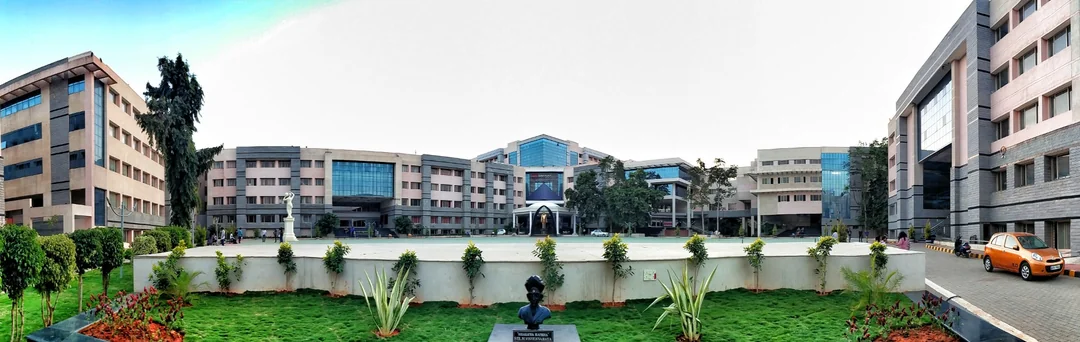
Department Faculty
Meet the educators and researchers guiding our department.

Labs & Infrastructure
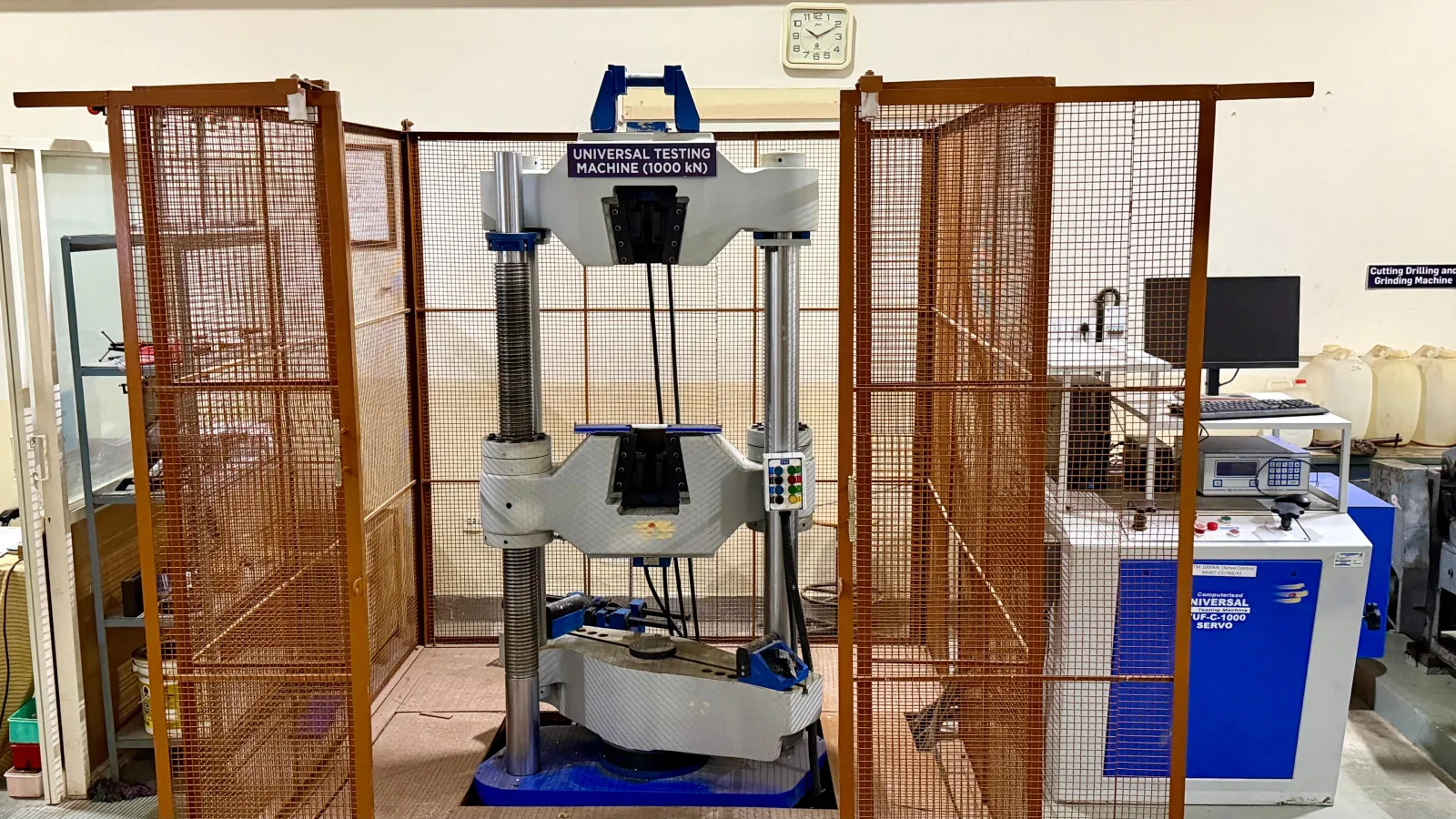
Strength of Materials Laboratory
The Materials Testing Laboratory (CVL37) provides students with practical experience in evaluating the mechanical properties, strength, and performance of engineering and construction materials. The laboratory focuses on testing ferrous and non-ferrous metals, steel, wood, and tiles through experiments such as hardness, impact, tensile, compression, shear, bending, torsion, flexural strength, re-bend, and Young’s modulus tests. Students develop the ability to conduct standardized experiments, accurately record and analyze experimental data, interpret material behaviour under different loading conditions, and assess material suitability in accordance with relevant Indian Standard (IS) codes. The laboratory also develops competency in equipment handling, laboratory safety, technical reporting, experimental analysis, and engineering judgment. Overall, the course bridges theoretical concepts with practical material characterization and prepares students for applications in structural engineering, construction, material quality control, testing laboratories, and professional engineering practice.
Strength of Materials Laboratory
The Materials Testing Laboratory (CVL37) provides students with practical experience in evaluating the mechanical properties, strength, and performance of engineering and construction materials. The laboratory focuses on testing ferrous and non-ferrous metals, steel, wood, and tiles through experiments such as hardness, impact, tensile, compression, shear, bending, torsion, flexural strength, re-bend, and Young’s modulus tests. Students develop the ability to conduct standardized experiments, accurately record and analyze experimental data, interpret material behaviour under different loading conditions, and assess material suitability in accordance with relevant Indian Standard (IS) codes. The laboratory also develops competency in equipment handling, laboratory safety, technical reporting, experimental analysis, and engineering judgment. Overall, the course bridges theoretical concepts with practical material characterization and prepares students for applications in structural engineering, construction, material quality control, testing laboratories, and professional engineering practice.
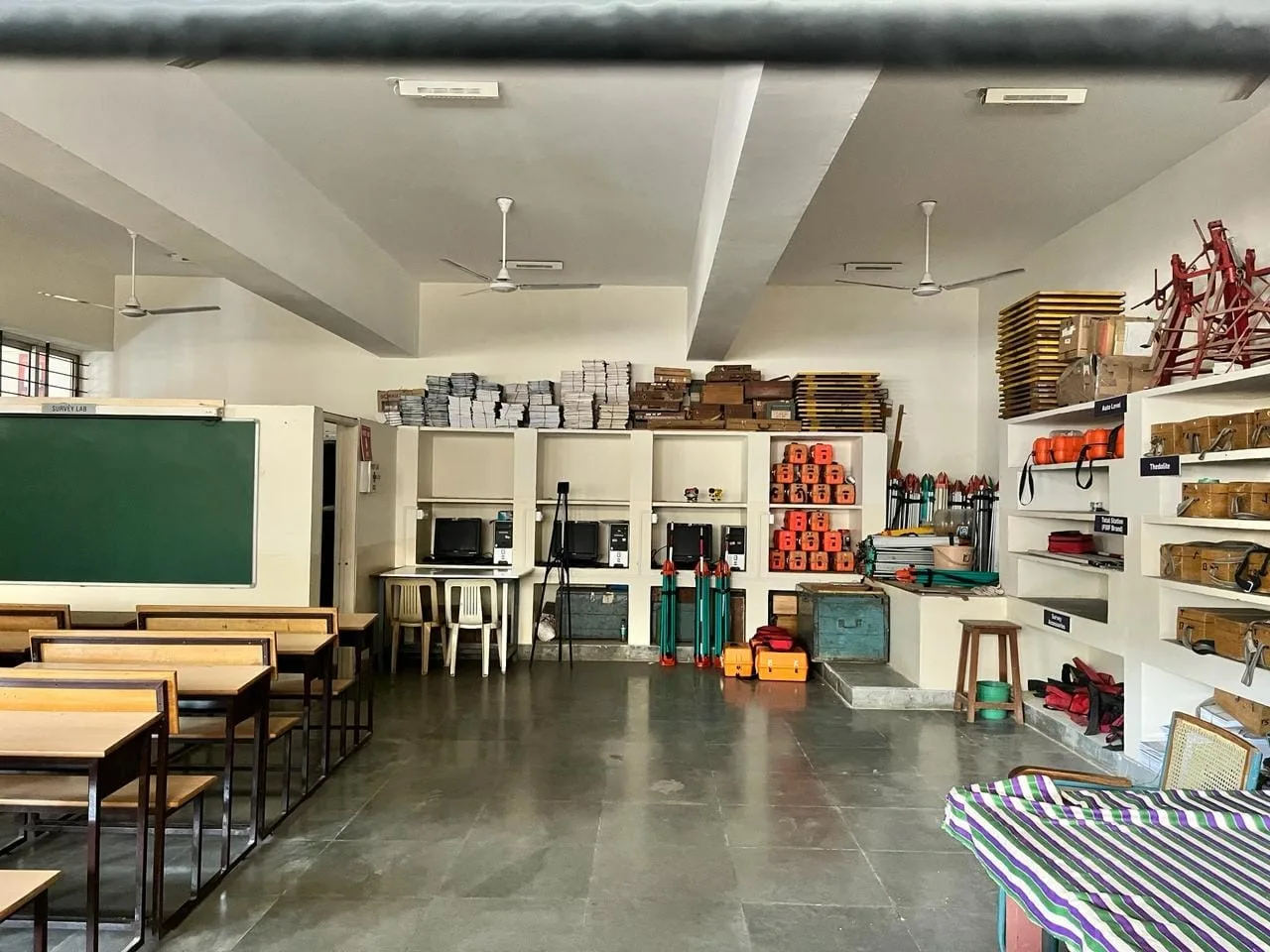
Geoinformatics and Digital Surveying Laboratory
The Geoinformatics and Digital Surveying Laboratory in the Department of Civil Engineering is well-equipped to provide students with hands-on training in conventional, digital, and precision surveying techniques. The laboratory houses traditional instruments such as chains, tapes, compasses, plane tables, dumpy levels, and transit theodolites, along with advanced equipment including precision theodolites, Digital Levels (Lawrence & Mayo), Digital Planimeter (Lawrence & Mayo), Pentax Auto Level (Lawrence & Mayo), Garmin eTrex GPS receivers, Total Stations, and Ceylon Ghat Tracers. These facilities enable students to gain practical knowledge in distance and angle measurement, levelling, traversing, area measurement, GPS-based positioning, coordinate determination, mapping, and topographic surveying. The laboratory integrates fundamental surveying principles with modern geospatial technologies, providing students with essential skills for applications in land surveying, construction, infrastructure development, mapping, and other civil engineering projects.
Geoinformatics and Digital Surveying Laboratory
The Geoinformatics and Digital Surveying Laboratory in the Department of Civil Engineering is well-equipped to provide students with hands-on training in conventional, digital, and precision surveying techniques. The laboratory houses traditional instruments such as chains, tapes, compasses, plane tables, dumpy levels, and transit theodolites, along with advanced equipment including precision theodolites, Digital Levels (Lawrence & Mayo), Digital Planimeter (Lawrence & Mayo), Pentax Auto Level (Lawrence & Mayo), Garmin eTrex GPS receivers, Total Stations, and Ceylon Ghat Tracers. These facilities enable students to gain practical knowledge in distance and angle measurement, levelling, traversing, area measurement, GPS-based positioning, coordinate determination, mapping, and topographic surveying. The laboratory integrates fundamental surveying principles with modern geospatial technologies, providing students with essential skills for applications in land surveying, construction, infrastructure development, mapping, and other civil engineering projects.
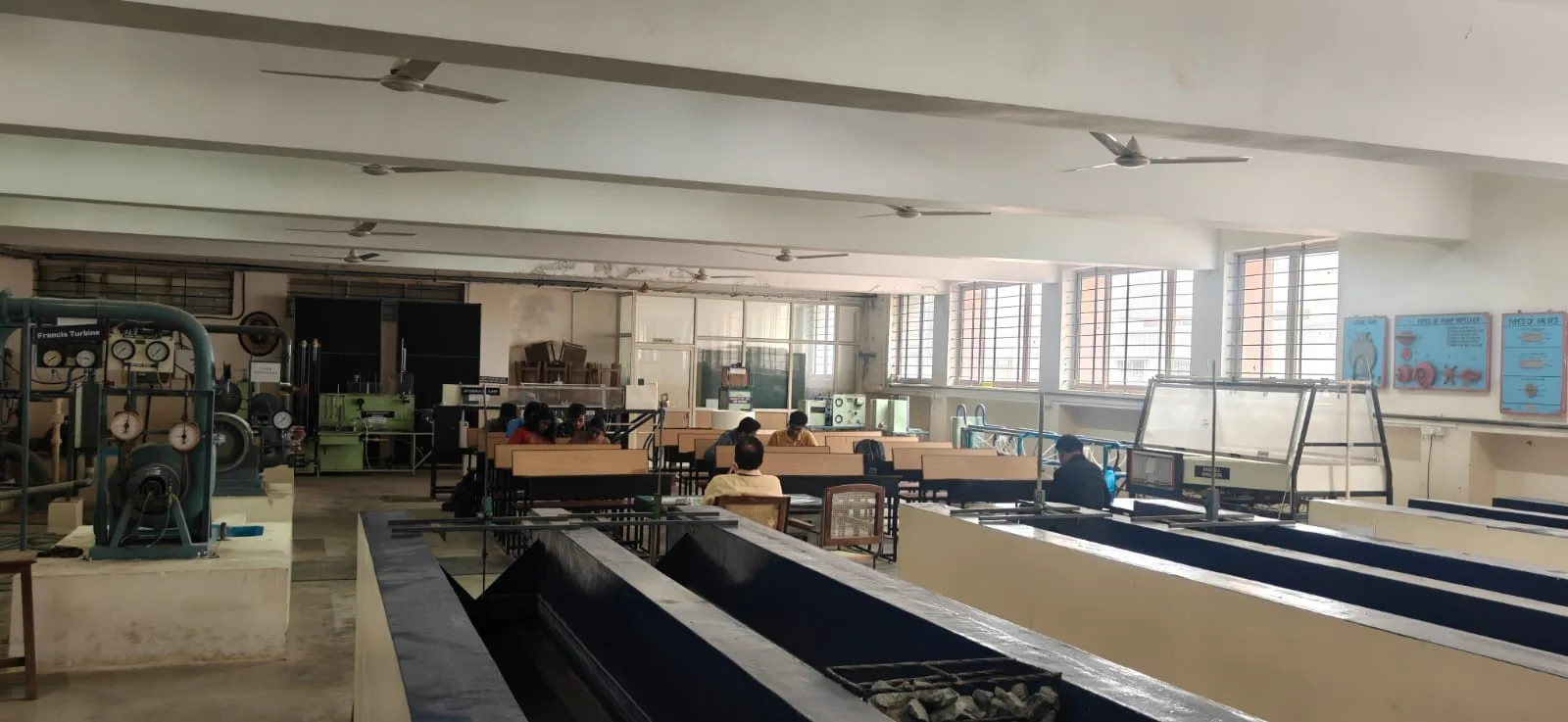
Fluid Mechanics Laboratory
This laboratory is equipped to help students to understand concepts learnt in the theory course of Fluid Mechanics & Hydraulics and to boost research in the field of hydrology. For academic purpose, lab is equipped with set up for calibration of notches & weirs in open channel flow and venturimeter & orifice meter in pipe flow, equipment to estimate losses in pipe flow, Reynold’s experiment, Bernoulli’s experiment and hydrostatic bench for verification and visualization of basic principles of fluid mechanics and set up of Impact of jet on Vanes, pumps and turbines to evaluate Performance characteristics of hydraulic machines. Lab is equipped with Infiltrometer, Rainfall simulator and set up for hydraulic jump to aid research.
Fluid Mechanics Laboratory
This laboratory is equipped to help students to understand concepts learnt in the theory course of Fluid Mechanics & Hydraulics and to boost research in the field of hydrology. For academic purpose, lab is equipped with set up for calibration of notches & weirs in open channel flow and venturimeter & orifice meter in pipe flow, equipment to estimate losses in pipe flow, Reynold’s experiment, Bernoulli’s experiment and hydrostatic bench for verification and visualization of basic principles of fluid mechanics and set up of Impact of jet on Vanes, pumps and turbines to evaluate Performance characteristics of hydraulic machines. Lab is equipped with Infiltrometer, Rainfall simulator and set up for hydraulic jump to aid research.
Concrete Laboratory
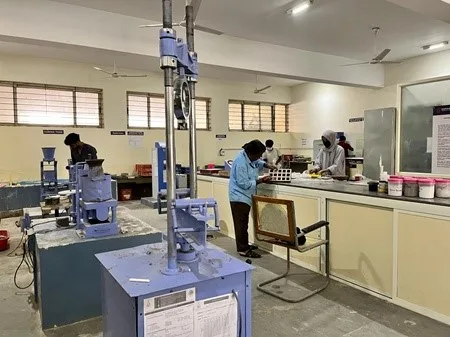
The Concrete Laboratory in the Department of Civil Engineering at Ramaiah Institute of Technology (MSRIT) is a premier testing and research facility. It serves 4th- and 5th-semester civil engineering students for core curriculum coursework—including Basic Material Testing and Concrete Technology laboratories—while providing 8th-semester students with an advanced platform for capstone projects, Self-Compacting Concrete (SCC) optimization, and durability studies. • Aggregate Characterization: Equipped with mechanical sieve shakers holding complete sets of fine and coarse aggregate sieves, a heavy-duty jaw crusher, a pulverizer, and drying ovens for gradation, particle size distribution, and moisture analysis. • Cement & Binder Testing: Features Vicat’s apparatus, Blaine’s air permeability apparatus, cement autoclave machine, heat of hydration apparatus, flow table, and mortar mixers/vibrators for evaluating consistency, setting times, fineness, hydration kinetics, and soundness. • Fresh Concrete Rheology: Supports workability assessments via slump cone, compaction factor apparatus, Vee-Bee consistometer, table vibrator, air entrainment meter, and specialized SCC testing apparatus (L-box, V-funnel, U-box, and J-ring). • Mechanical Strength Testing: Houses 200-ton and 3000 kN Compression Testing Machines, a flexure testing machine, and a concrete core cutting machine for measuring compressive strength, modulus of rupture, and structural core extraction. • Conditioning & Durability: Contains a constant-temperature humidity chamber, accelerated curing tank, and muffle furnace for environmental curing, loss-on-ignition, and long-term durability testing.
Concrete Laboratory
The Concrete Laboratory in the Department of Civil Engineering at Ramaiah Institute of Technology (MSRIT) is a premier testing and research facility. It serves 4th- and 5th-semester civil engineering students for core curriculum coursework—including Basic Material Testing and Concrete Technology laboratories—while providing 8th-semester students with an advanced platform for capstone projects, Self-Compacting Concrete (SCC) optimization, and durability studies. • Aggregate Characterization: Equipped with mechanical sieve shakers holding complete sets of fine and coarse aggregate sieves, a heavy-duty jaw crusher, a pulverizer, and drying ovens for gradation, particle size distribution, and moisture analysis. • Cement & Binder Testing: Features Vicat’s apparatus, Blaine’s air permeability apparatus, cement autoclave machine, heat of hydration apparatus, flow table, and mortar mixers/vibrators for evaluating consistency, setting times, fineness, hydration kinetics, and soundness. • Fresh Concrete Rheology: Supports workability assessments via slump cone, compaction factor apparatus, Vee-Bee consistometer, table vibrator, air entrainment meter, and specialized SCC testing apparatus (L-box, V-funnel, U-box, and J-ring). • Mechanical Strength Testing: Houses 200-ton and 3000 kN Compression Testing Machines, a flexure testing machine, and a concrete core cutting machine for measuring compressive strength, modulus of rupture, and structural core extraction. • Conditioning & Durability: Contains a constant-temperature humidity chamber, accelerated curing tank, and muffle furnace for environmental curing, loss-on-ignition, and long-term durability testing.
Highway Engineering Laboratory
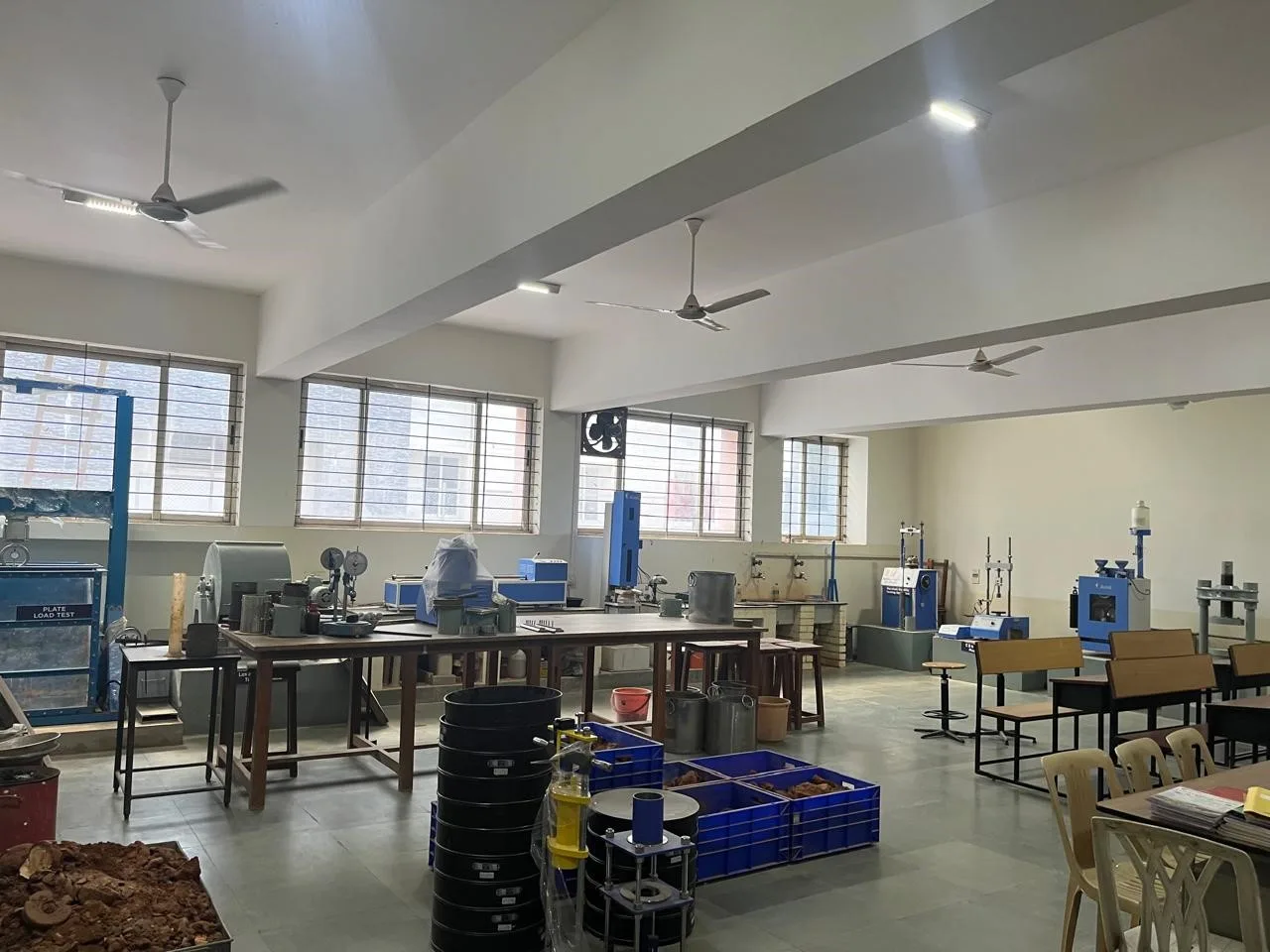
The Highway Engineering Laboratory provides practical training in testing highway materials. Students evaluate aggregates, bitumen, bituminous mixes, and subgrade soil through standard tests. The experiments assess material strength, durability, consistency, deformation, and pavement suitability, enabling students to interpret results and select appropriate materials for safe, economical, and durable highway construction.
Highway Engineering Laboratory
The Highway Engineering Laboratory provides practical training in testing highway materials. Students evaluate aggregates, bitumen, bituminous mixes, and subgrade soil through standard tests. The experiments assess material strength, durability, consistency, deformation, and pavement suitability, enabling students to interpret results and select appropriate materials for safe, economical, and durable highway construction.
Geotechnical Engineering Laboratory
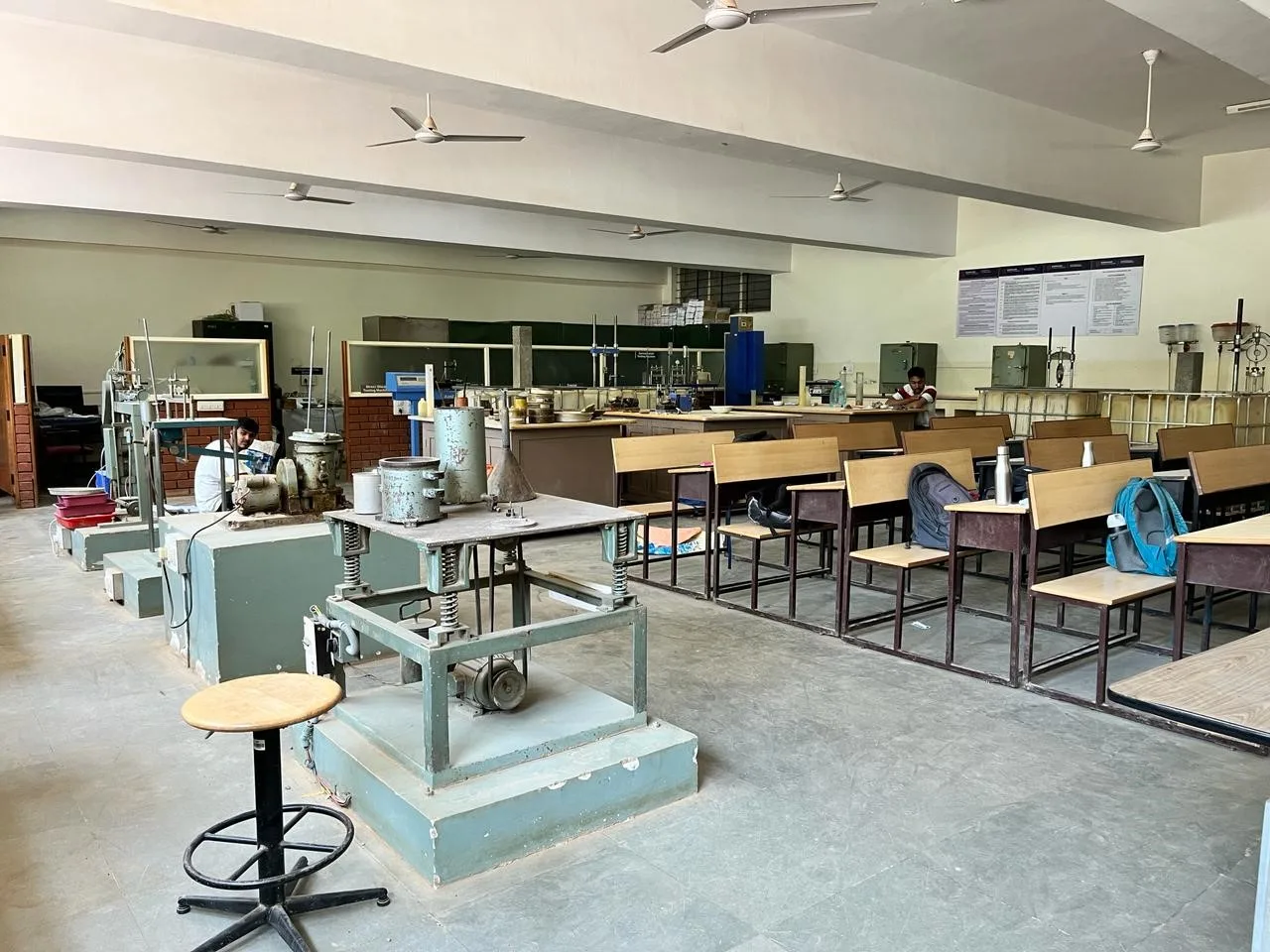
This laboratory helps the students to understand the various properties of earth (soil) used for various types of constructions in different geographical regions. Some of the soil properties tested include relative density, permeability, shear test, compaction & consolidation test, confined and unconfined tests and also standard penetration test.
Geotechnical Engineering Laboratory
This laboratory helps the students to understand the various properties of earth (soil) used for various types of constructions in different geographical regions. Some of the soil properties tested include relative density, permeability, shear test, compaction & consolidation test, confined and unconfined tests and also standard penetration test.
Computer Laboratory
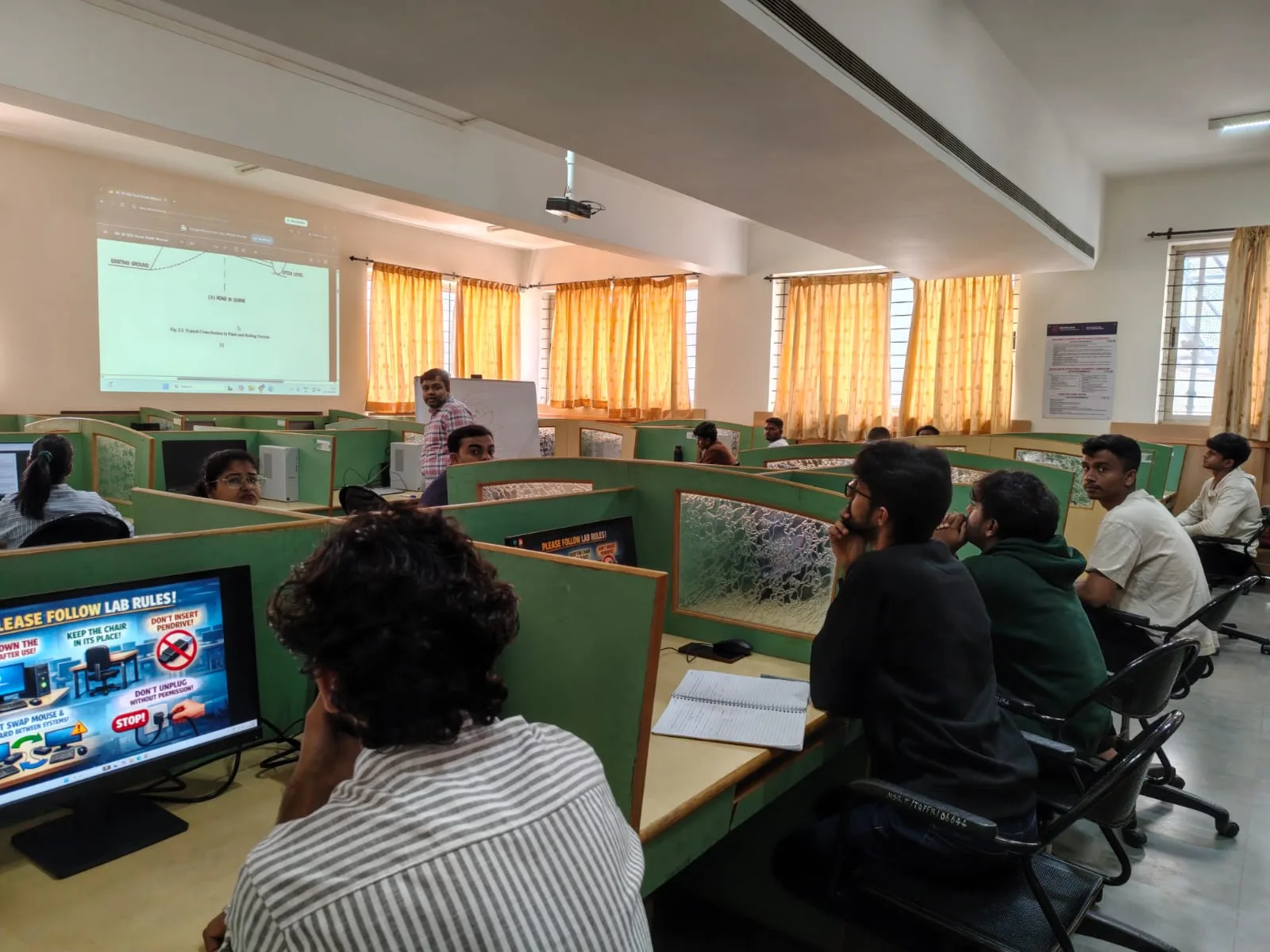
The Computer Laboratory of the Department of Civil Engineering is equipped with modern software facilities to support teaching, learning, design, analysis, and project work. The laboratory provides hands-on training in AutoCAD, STAAD.Pro, ETABS, MS Project, MS Excel, QGIS, SW-DTM, and Revit. These software tools enable students to develop technical drawings, perform structural analysis and design, carry out engineering calculations and data analysis, prepare project schedules, work with GIS and terrain data, and create Building Information Models (BIM). The laboratory supports students in developing practical skills relevant to current civil engineering practices and professional applications.
Computer Laboratory
The Computer Laboratory of the Department of Civil Engineering is equipped with modern software facilities to support teaching, learning, design, analysis, and project work. The laboratory provides hands-on training in AutoCAD, STAAD.Pro, ETABS, MS Project, MS Excel, QGIS, SW-DTM, and Revit. These software tools enable students to develop technical drawings, perform structural analysis and design, carry out engineering calculations and data analysis, prepare project schedules, work with GIS and terrain data, and create Building Information Models (BIM). The laboratory supports students in developing practical skills relevant to current civil engineering practices and professional applications.
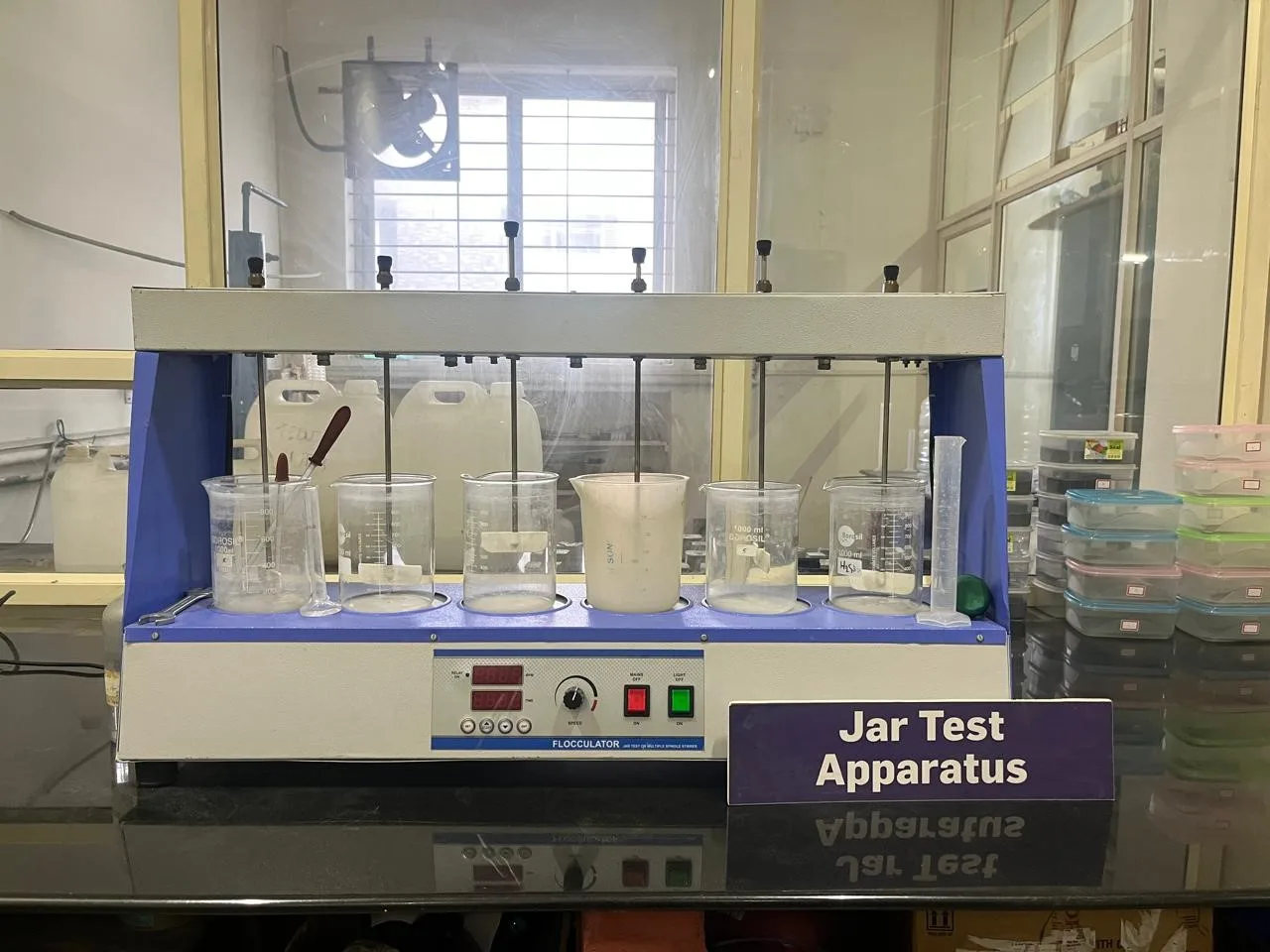
Environmental Engineering Laboratory
The Environmental Engineering Laboratory in the Civil Engineering Department provides students with practical exposure to water and wastewater quality analysis, environmental monitoring, and pollution control. The laboratory enables the application of fundamental environmental engineering principles through the analysis of physical and chemical parameters, operation of laboratory instruments, sample handling, interpretation of experimental results, and comparison with relevant environmental standards.
Environmental Engineering Laboratory
The Environmental Engineering Laboratory in the Civil Engineering Department provides students with practical exposure to water and wastewater quality analysis, environmental monitoring, and pollution control. The laboratory enables the application of fundamental environmental engineering principles through the analysis of physical and chemical parameters, operation of laboratory instruments, sample handling, interpretation of experimental results, and comparison with relevant environmental standards.
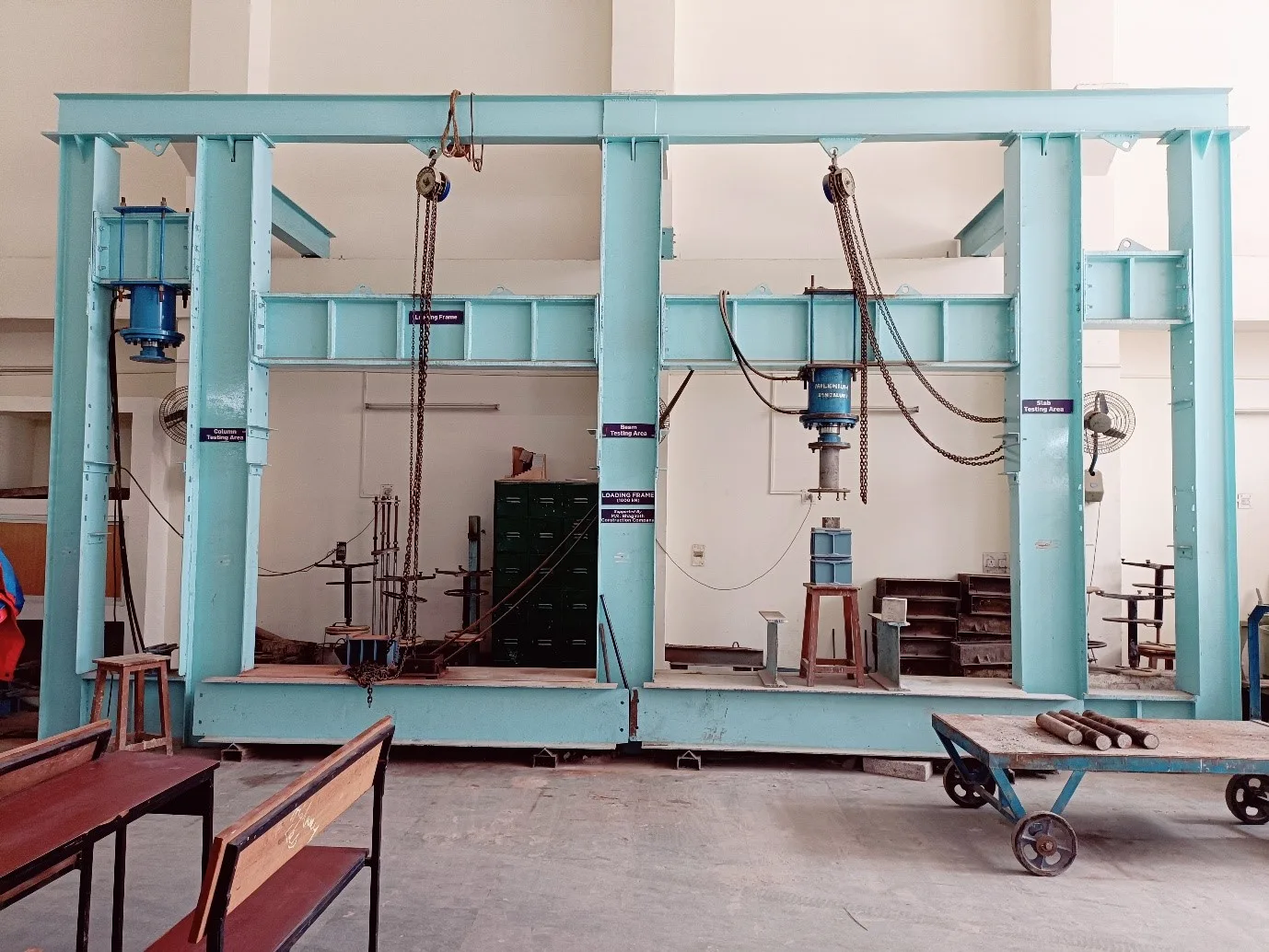
Structural Engineering Laboratory
The Structural Engineering Laboratory is equipped with advanced experimental facilities for the testing, evaluation, and performance assessment of structural elements and systems. The laboratory houses a 1000 kN Loading Frame integrated with a 16-channel Data Acquisition System, enabling accurate measurement and recording of structural response under controlled loading conditions. The facility supports experimental testing of a wide range of structural components and systems, including reinforced concrete beams, slabs, columns, beam-column junctions, portal frames, and masonry walls. The laboratory is also supported by specialized environmental and curing facilities, including a steam curing chamber and humidity chamber, facilitating controlled curing and conditioning of concrete and other construction materials. The laboratory provides a platform for undergraduate and postgraduate teaching, project work, research, structural testing, material characterization, and experimental validation of analytical and numerical studies. It enables students and researchers to study structural behaviour, load–deformation response, strength, serviceability, failure mechanisms, and the effectiveness of innovative construction materials and techniques under controlled laboratory conditions.
Structural Engineering Laboratory
The Structural Engineering Laboratory is equipped with advanced experimental facilities for the testing, evaluation, and performance assessment of structural elements and systems. The laboratory houses a 1000 kN Loading Frame integrated with a 16-channel Data Acquisition System, enabling accurate measurement and recording of structural response under controlled loading conditions. The facility supports experimental testing of a wide range of structural components and systems, including reinforced concrete beams, slabs, columns, beam-column junctions, portal frames, and masonry walls. The laboratory is also supported by specialized environmental and curing facilities, including a steam curing chamber and humidity chamber, facilitating controlled curing and conditioning of concrete and other construction materials. The laboratory provides a platform for undergraduate and postgraduate teaching, project work, research, structural testing, material characterization, and experimental validation of analytical and numerical studies. It enables students and researchers to study structural behaviour, load–deformation response, strength, serviceability, failure mechanisms, and the effectiveness of innovative construction materials and techniques under controlled laboratory conditions.
Non-Destructive Testing and Dynamics laboratory
Non-Destructive Testing and Dynamics laboratory
Top Recruiters & Industry Collaboration
Top Recruiters









Industry Partners / Collaborations
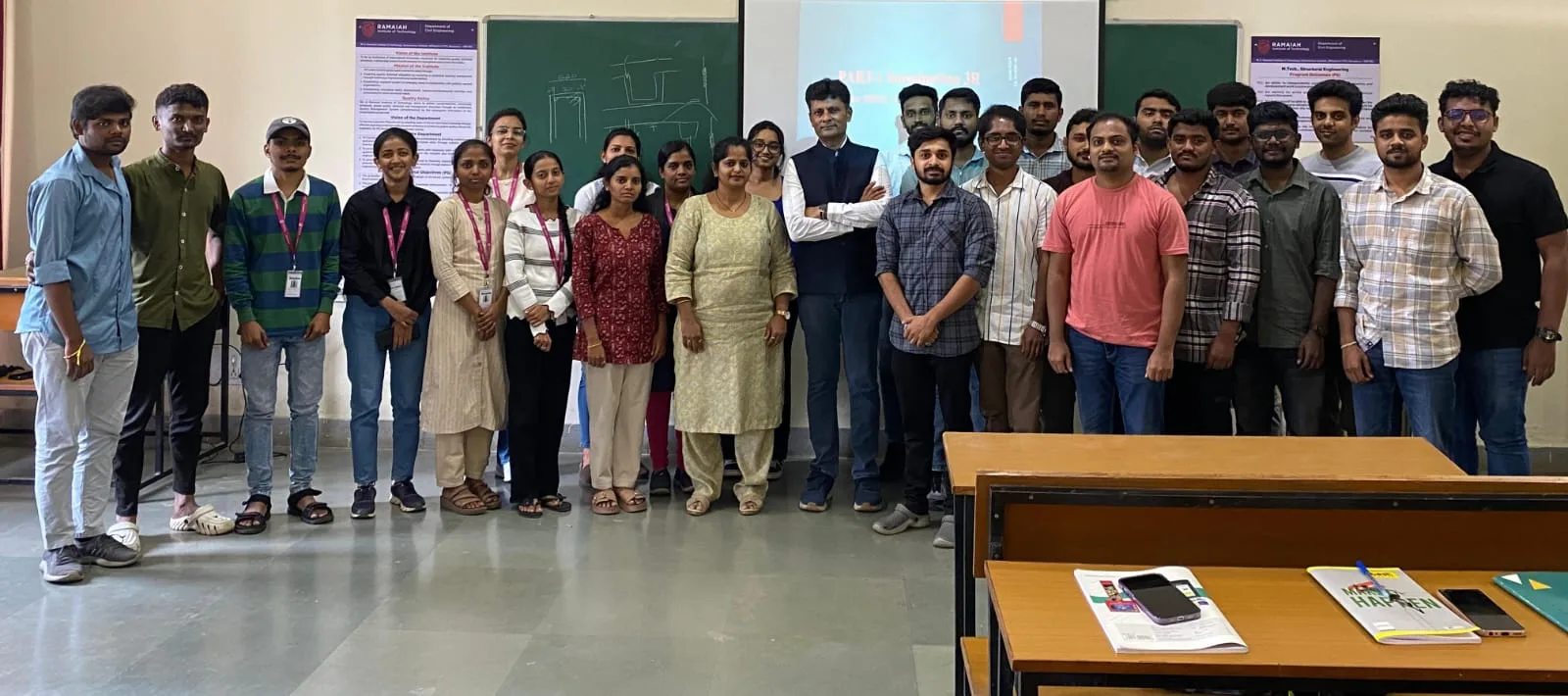
Collaboration with PEMS, 3E SERVICES Construction Engineering, Verdant Building Alternatives (OPC) Private Limited
Partial Delivery For the UG and PG Subjects
Placements
Research Areas
Achievements
- NBA Accreditation Renewed for both UG and PG in 2024
- External research grants worth Rs. 1.25 crore
- Consultancy revenue worth Rs.42 lakh last four years
- Department has awarded 30 Ph.D. degrees and currently supports 24 ongoing doctoral scholars
- More than 200 indexed journal publications during the past five years.
Board of Studies
View the members of the Board of Studies for this department.
View Members